Paul Bright
provides a detailed overview of Colombia's coal
geology, mining industry and export infrastructure.
1
A
long with other coal producing and exporting countries, the coal industry in Colombia has
been affected in the last few years by the international financial crisis, falling coal prices and a
weakening of demand for coal.
Within Colombia, there has also been increasing environmental and social pressures, as
well as regulatory standards, logistical problems, industrial and contractual issues, that have impacted
coal production. In the same period, there have been higher environmental improvements to Colombia’s
port capacity, as well as road and rail transport infrastructure.
In the last five years, average coal prices for Colombian thermal coal have dropped by some 37% from
a high of US$86/t to just under US$50/t. In the last year, the drop was 28% from a high of just under
US$70/t. It has been reported that the National Mining Agency has reduced its forecast for coal output for
2015 to 87 million t from 97.8 million t – approximately the same tonnage as 2011.
Total world hard coal production reached a record level of 7822.8 million t in 2013 – an increase of 0.4%
in comparison to the previous year. In the same year, Colombia produced 81 million t, just under 1% of the
world’s production, placing Colombia outside of the top ten producers – although Colombia ranked 9
th
in
thermal coal production. However, in terms of world coal trade, Colombia is a far more important player.
In 2013, total world thermal coal exports were estimated at 1028 million t, while Colombia exported
73 million t (approximately 0.70%), placing it 4
th
in the world league table.
Geology
Coal is widespread in Colombia, occurring in stratigraphic units ranging in age from Lower Cretaceous to
Upper Oligocene, with a wide range of rank and quality from lignite to anthracite (including metallurgical
coals). Geological structures can be complex: folding, faulting and overthrusting, with consequent
repetition of seams, which may result in multiple seam sites with seams up to 7 m or more in thickness
and amenable to opencast operations. In less favourable conditions, seams are thinner and more widely
separated by interburden and, at best, are amenable to underground mining.
Coal production and exports, however, continue to be dominated by thermal coal production from
opencast mines in the Eocene Cerrejón formation and the Palaeocene and Lower Eocene Los Cuervos
formation in the Guajira and Cesar departments respectively.
The physiography of Colombia is dominated by the western, central and eastern cordilleras of the
Colombian Andes, which are divided by the valleys of the Magdalena, Cauca and other rivers. The
locations of the Guajira and Cesar deposits in the flatter lowlands of the César-Rancheriá river valleys,
along with favourable geological conditions, have been factors in the development of world‑class,
low‑cost opencast mines in these areas. Colombian mining costs for thermal coals from these mines are
competitive with those of Indonesia andAustralia, among other low cost producers. The deposits are
located in the César-Rancheríá Basin of Tertiary age, which includes all of the mines within the Cesar and
Guajira provinces (including the Cerrejón complex). The basin is bounded by the east‑west striking Oca
Fault to the north, by the igneous massif of the Sierra Nevada de Santa Marta to the northwest, by the
Perija Mountains to the southeast and by a system of large faults to the west.
The CCX project at San Juan, southwest of Cerrejón, has reported significant resources and has been
added to the list of Projects of National Importance maintained by the National Mining Agency, although
the project, which contains predominantly underground mining resources potential, has not yet moved to
the exploitation stage. (
Editor's note: for more on the CCX project, see Barry Baxter’s article “Feeling the pinch”,
p. 14.
)
Within the limits of the basin, some 3500 m
2
are covered by alluvial deposits, which mask the
underlying geology. This area does not appear to have been systematically explored to date and the
possibility of further discoveries cannot be ruled out.
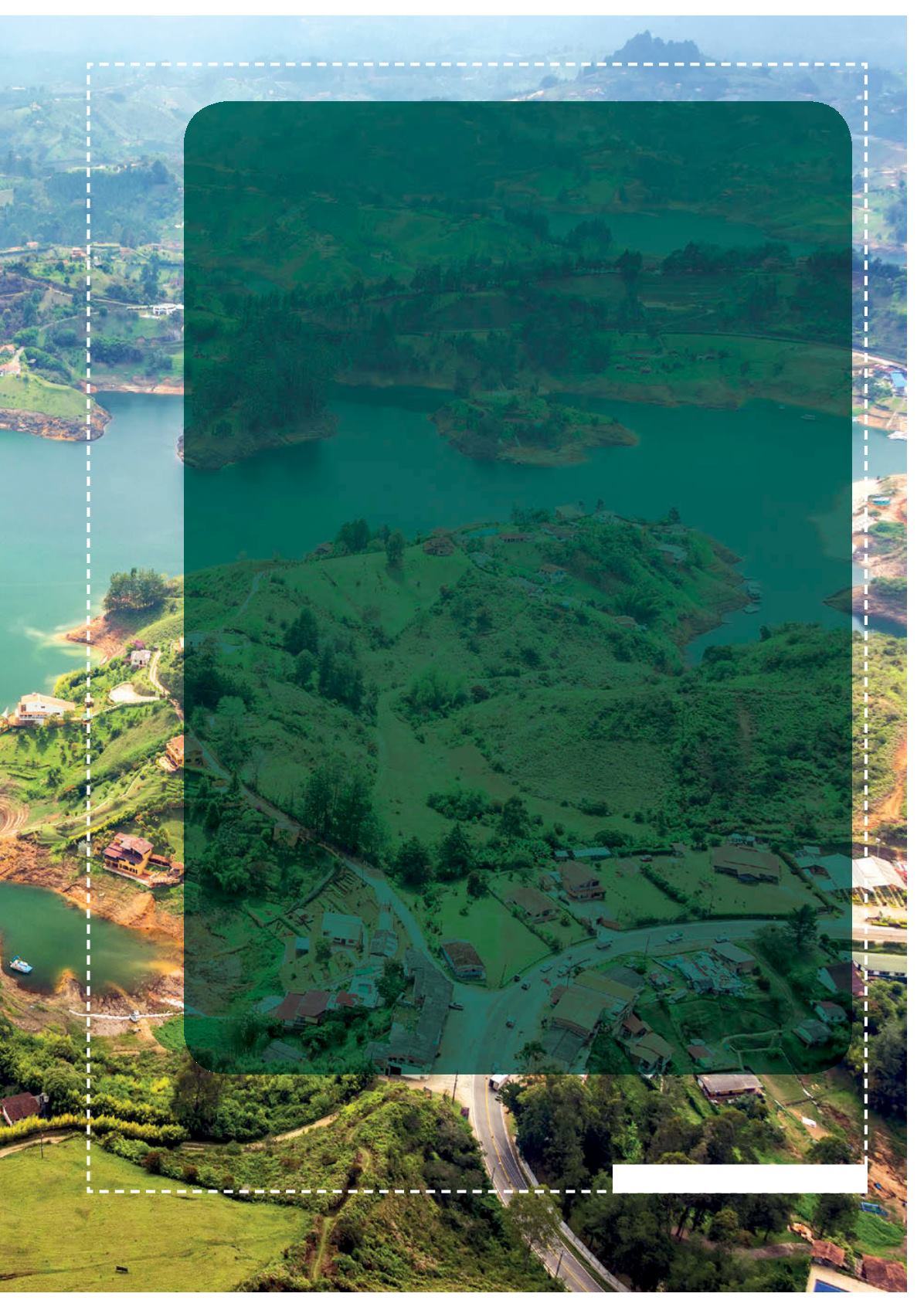
Arial view of Lake Guatape, Colombia
December 2015
|
World Coal
|
17


