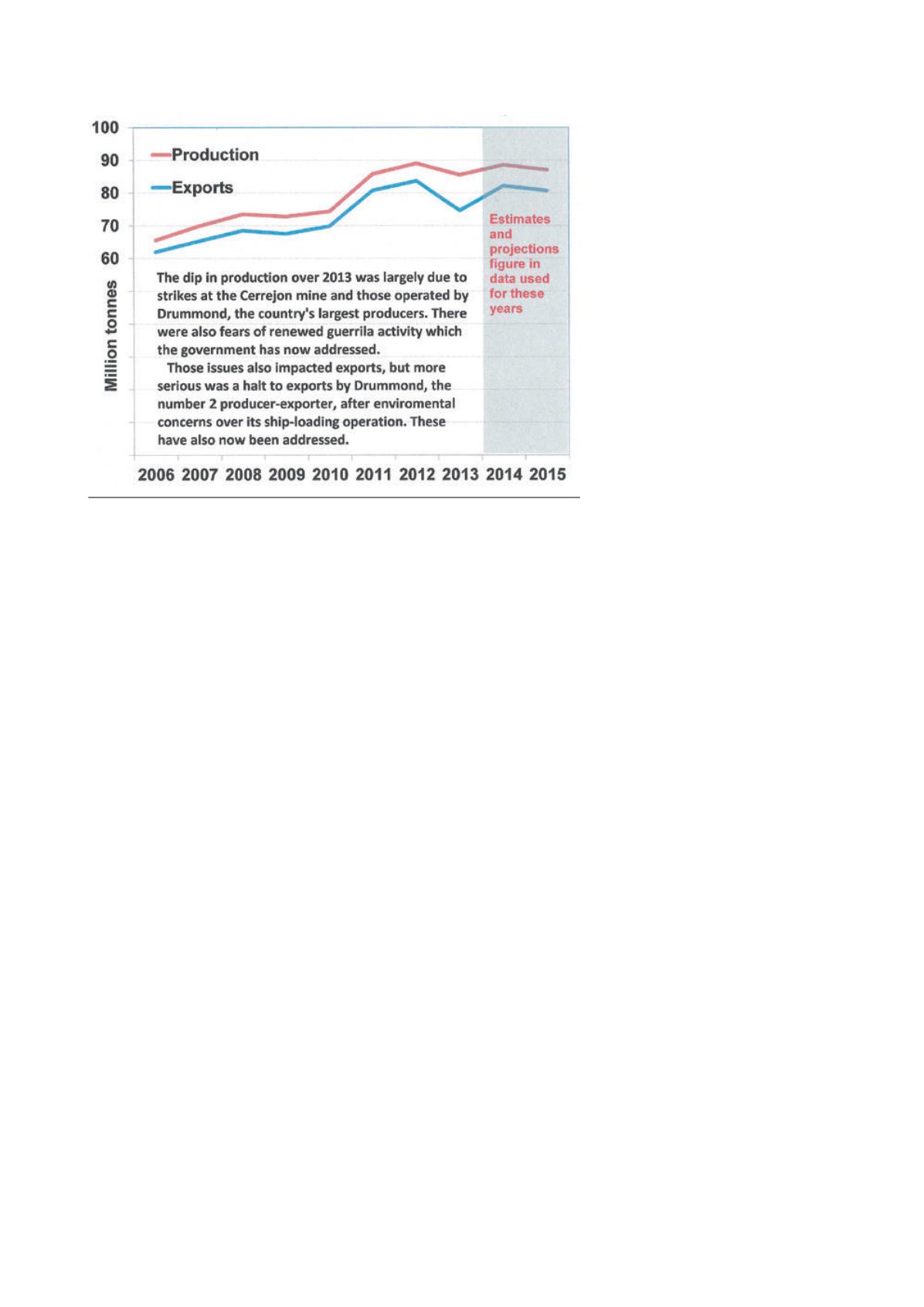
likely that production over 2015 will be
closer to 87 million t, bringing the five
years growth to just 1.4%, a drop of 12
points on the previous five years.
The country had a proven reserve of
6476 million t as at the end of 2014, the
world’s 12
th
largest and the largest in
Latin America. At the current rate of
production, there is enough coal to
sustain 76 yr of mining.
Export
Over 2012, Colombia exported
83.7 million t. Ranking 5
th
in the world,
it joined Indonesia, Australia, Russia and
the US in the group of countries that
export 80% of the world’s total. Over
2013, with exports at 74.6 million t, it
most likely took the place of the US in
the top four.
Over the five years 2004 – 2008,
exports grew 26%, while over
2009 – 2013 they dropped four points to
22%. Growth over the five years from
2011 to 2015 is expected to be marginally
negative: <0.1%, dropping 13 points
against 2006 – 2010. However, if
production does not slide to 87 million t
over 2015, exports may not be hit so
hard with five year growth dropping no
more than two points. There would be
more coal, but would there be demand
for it?
The Organisation for Economic
Cooperation and Development (OECD)
recently reported that in 2013 coal and
solid fuels manufactured from coal
totalled 11% of the country’s total
exports – well behind the export of
petroleum and crude oil at 54%. But to
better establish the true value of both
coal exports and production to the
Colombian economy, this must be read
against the current primary energy mix
– and what is happening to it as the
major contributor, oil, runs out.
Adding it all up
Colombia’s primary energy mix in
2014 was 11% coal, 37% oil, 25%
natural gas, 26% hydro and <1%
renewables. Coal represented
4.2 million t of oil equivalent (toe) or
6.5 million t of coal. Oil represented
14.5 million toe, meaning 22.3 million t
of coal – or 25% of total coal
production – would be needed to
replace it. Hydro represented
10.1 million toe, requiring
15.6 million t (17.5% of production) of
coal to replace it; natural gas
accounted for 9.8 million toe, requiring
15 million t of coal to replace it, 17% of
production.
The replacement coal could only
come from reducing exports, which
means that Colombia will need to use a
significant amount of its then current
export coal to replace oil in the energy
mix when it runs out in about seven
years (at the current rate of
consumption) and then to replace
natural gas in another seven years when
that reserve is also exhausted.
These projections are not just threats,
they are what will happen unless
Colombia can find more natural gas, oil,
other energy sources, or more coal
export destinations – and that in the face
of falling export demand from Europe
and the US.
That said, not all replacement energy
need come from coal as Colombia’s
potential for more hydropower is second
only to that of Brazil, where 75% of all
primary energy comes from hydro.
Colombia, the US and Asia
Greater domestic demand for
Colombia’s coal is only one side of the
coin when it comes to its export
potential. On the other side is a
slowdown in coal demand from the
traditional markets: Europe, which takes
67% of Colombia's coal exports, and the
US, which takes about 4%.
Another question has to be: could
Asia figure more prominently in the
calculations? The answer to this is a
definite ‘very likely’.
It is clear that any potential for an
increase in Colombian exports to the US
is of only slight significance; the current
figure of 7.5 million t already covers 73%
of total US coal imports.
President Obama’s ‘war on coal’ in
the US may be hitting the coal industry
in that country hard, but it is having a
positive impact on the industry in
Colombia.
Adeal completed in June 2011 by
US-based coal miner Drummond,
spurred by the growing adverse attitude
towards the coal industry in the US,
gave Japan’s Itochu Corp. a stake in
Drummond International, which now
owns and operates the US company’s
Colombian interests. The partnership
aims to increase coal exports to Japan
and other Asian countries. The deal was
spurred by stricter US government
regulations that were causing coal-fired
power plants to close and no new ones
to be built.
Four years later in August 2015, US
producer Murray Energy Corp., for the
same reasons, acquired Colombia
Natural Resources, which includes two
Colombia coal production and exports.
12
|
World Coal
|
December 2015


