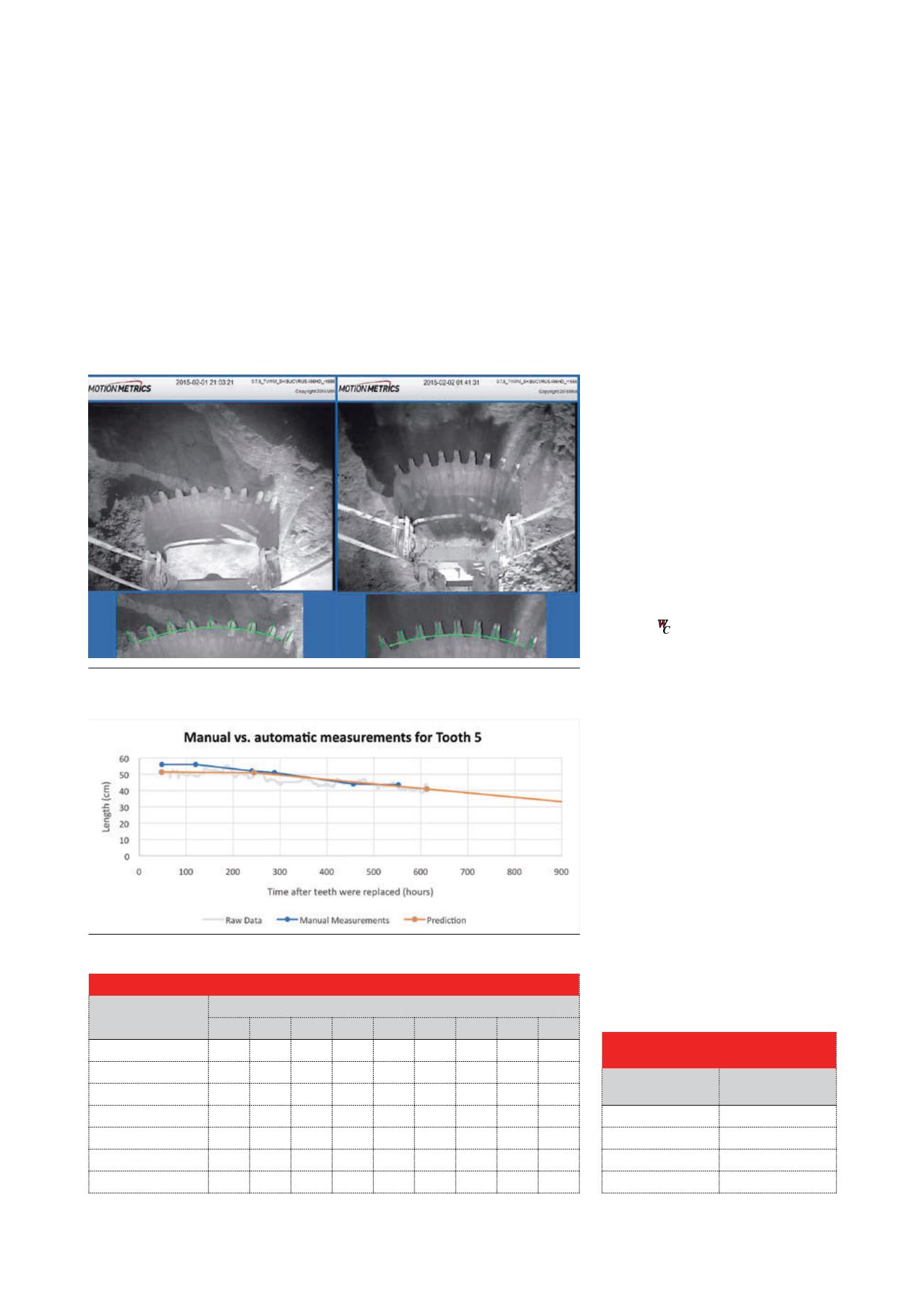
green demonstrate the accuracy of the
machine vision based approach.
The prediction line in Figure 5 is for
predicting the tooth change date for
the given tooth. The tooth was
installed on 2 February and replaced
on 5 March. The whole interval lasted
31 days. Table 5 shows the predicted
tooth change date for the four days
leading up to the actual replacement
date.
In the four days leading up to the
change-out, the prediction was
accurate to the exact date. This study
demonstrates that the ShovelMetrics™
Tooth Wear Monitoring System is a
suitable replacement for manual
measurements and is capable of
providing accurate change-out
predictions.
Conclusion
Tooth change-out costs can be justified
by proper planning, optimal
replacement intervals and careful
monitoring of tooth wear:
n
n
Optimal replacement intervals can
be estimated with previous tooth
failure data and could potentially
result in annual savings of
US$20 000, as demonstrated in this
case study of an iron mine.
n
n
The automated ShovelMetrics™
Tooth Wear Monitoring System used
in the case study was determined
to be a suitable replacement for
manual measurements. The system
is able to measure teeth at a much
higher frequency that is beyond the
possibility of manual measurement
methods.
n
n
The prediction of tooth change-out
was accurate to the exact date in the
four days leading up to the actual
replacement.
n
n
The automated Tooth Wear
Monitoring System provides a
variety of real-time and historical
data that is useful for determining
optimal replacement intervals.
Since the system tracks each
tooth individually, more complex
change‑out strategies could be
used.
References
1. DELVALLE, V., PARSONS, L., PATNAYAK,
S. TANNANT, D.D. and WONG, J.,
‘Operator and dipper tooth influence on
electric shovel performance during oil sands
mining’,
International Journal of Mining,
Reclamation and Environment
, Vol. 22, No. 2
(2008), pp. 120 – 145.
2. FERNANDEZ, J.E., VIJANDE, R.,
TUCHO, R., RODRIGUEZ, J. MARTIN, A.,
‘Materials selection to excavator teeth in
mining industry’.
Wear
, (2001), 250:11-18.
3. KNIGHTS , P. F., ‘Optimal replacement
intervals for shovel dipper teeth’,
International Journal of Mining, Reclamation
and Environment
, Vol. 23, No. 3 (2009),
pp. 157.
4. KNIGHTS, P. F. and SEGOVIA, R. A.,
‘Reliability model for the optimal
replacement of shovel cables’,
Transactions
of the Institution of Mining and Metallurgy,
Section A – Mining Technology
, (1999)
pp. 8 – 16.
Table 4. Manual tooth length measurements
Date
Tooth length (cm)
T1
T2 T3
T4 T5
T6 T7
T8 T9
2 February
56 56 56 56 56 56 56 56 56
5 February
56 56 56 56 56 56 56 56 56
10 February
56 56 54.5 53.5 52
52
52.5 53.5 56
12 February
56 55.5 53
51.5 51
51
50.5 52
55.5
19 February
53.5 52.5 49.5 45.5 44 43.5 43.5 47.5 52
23 February
53.5 51.5 48.5 44.5 43.5 43
42.5 46.5 51
3 March
49.5 45.5 40.5 33.5 32
31
33.5 38 46.5
Table 5. Predicted tooth change-out date
by ShovelMetrics
™
Date
Predicted
change‑out date
1 March
5 March
2 March
5 March
3 March
5 March
4 March
5 March
Figure 5. Tooth lengths from manual and automatic measurements with prediction.
Figure 4. Images captured by ShovelMetrics™ before the tooth change (left) and after
the tooth change (right).
30
|
World Coal
|
December 2015


