stable compared to diesel prices and
conveyors can be run at off peak
energy times.”
As Hanson explained further:
“Aside from initial capital cost,
operating expenses are the next major
measured costs in coal operations. The
capital cost of a conveyor can be
higher than a haul truck; however, no
matter what the distance, the cost of
operating a conveyor will be less.
Long-range costs show that conveyors
have limited inflationary effect and a
long life-span of at least 20 yr.”
Beyond cost, conveyors also benefit
product quality, said Hanson, because
they eliminate multiple handlings of
material, which prevents the
compaction and contamination
typically caused by trucks and/or
loaders, while telescoping conveyors
eliminate segregation and material
degradation.
“Continuous flow is another
advantage realised because conveyors
are not affected by weather, can be
fully automated and operated at the
touch of a button,” concluded Hanson.
A final advantage of conveyors is
their limited environmental impact
when compared to trucks, which emit
and stir up pollution – including dust
and noise – along the entire haulage
path. For example, Superior cites the
case of an aggregates producer that
proposed using a conveying system
when faced with government and
community resistance on the basis that
an environmental impact study showed
particulate matter (PM-10) emissions
would be 97.6% lower with a conveyor
than if using trucks and loaders.
1
In
addition, the conveyor would be
quieter and could be designed to blend
in with the environment.
The challenges of mobile
conveying
“Maintenance is the chief challenge,”
said Hanson. To this end, Superior
Industries has its own division
committed to conveyor component
design and manufacture. “Our
engineers are skilled in both facets of
material handling: the structure and
componentry,” Hanson continued.
“We design component solutions to
reduce or eliminate maintenance. For
example, Superior is credited as the
original designer and manufacturer of
the v-shaped wing pulley.”
The v-shaped wing pulley – which
Hanson called “one of the most
innovative conveyor component
solutions in recent years” – was
patented by the company in 2007 as the
Chevron
®
pulley. Its design is
engineered to prevent material buildup
and belt damage, while minimising
noise and vibration during operation.
“When compared to the conventional
wing pulley, the v-shaped pulley design
delivers numerous time-and-money-
saving advantages over traditional
choices,” Hanson concluded.
Technology development
Superior Industries has been active in
developing mobile conveyor
technologies in recent years. Back in
2010, the company launched its
Trailblazer
®
portable groundline
conveyor, a mobile overland conveyor
system that overturned the idea that
overland conveyors had to be fixed or
stationary. “This highly mobile, 500 ft,
fully-belted and assembled groundline
conveyor is easily towable from site to
site, allowing rapid deployment from
the road to working status in just
about an hour,” said the company
press release highlighting its launch.
“Unlike any other groundline
conveying system, which would
require days or even weeks for set-up
or teardown, the [Trailblazer] is
designed to deliver [...] savings in costs
and manpower, while also eliminating
the downtime associated with the
erection of traditional systems – and
the need to transport material onsite
via costly trucks or loaders.”
Other recent developments include:
n
n
The new Swing Axle XTP
TeleStacker conveyor, which cuts
the shift time required to change
from road to radial mode to just
5 – 10 min.
n
n
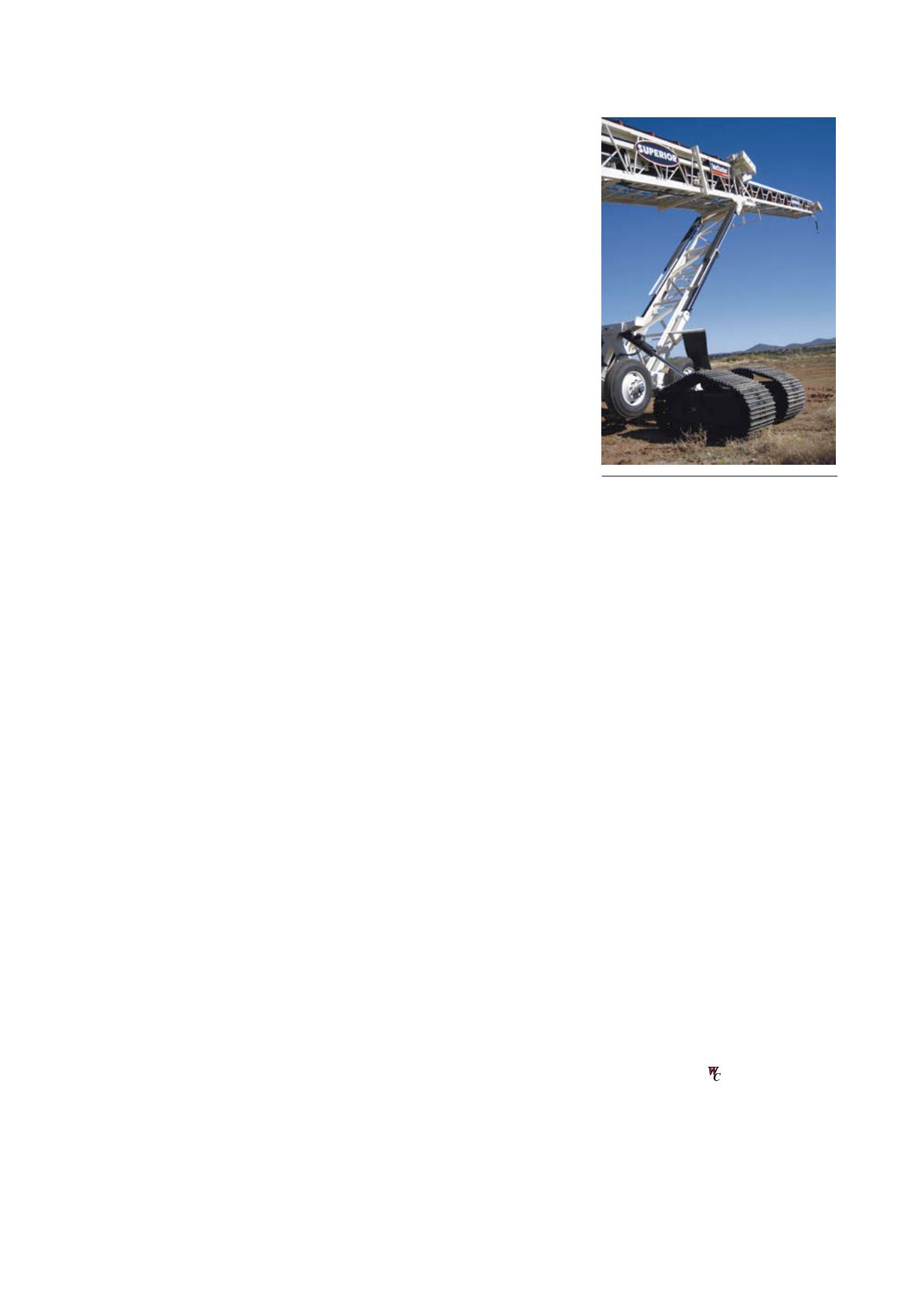
The Radial Travel Tracks conveyor
mobility option, which allows
high-capacity radial stockpiling
in applications – such as
low‑pressure soils, sand or clay –
where maximum floatation and
traction is required.
n
n
The Conveyor PilePro
®
12.0
automation program, which
includes bolder graphics and
touch‑screen operation to
improve user experience, as well
as including onscreen access to
the manual and a running meter
that reports the unit’s motor
hours.
Superior Industries was founded
in 1972 by Neil Schmidgall, who
started rebuilding and developing
machinery when working at his
father’s sand and gravel plants.
Since then, the company has
grown into a global provider of
bulk material processing and
handling systems, owning more
than two dozen patented
technologies and with customers
on six continents. It is based in
Morris, in the US state of
Minnesota, with manufacturing
plants in Arizona, Nebraska and
Georgia, as well as the Canadian
provinces of Alberta and
New Brunswick.
References
1. METZGER, D., ‘Long Distance
Conveying - Long Term Savings:
Conveyors vs Haul Trucks’ (Superior
Industries Technical Bulletin) (2007).
The Radial Travel Tracks conveyor
mobility option allows high‑capacity radial
stockpiling in applications demanding
maximum flotation and traction.
December 2015
|
World Coal
|
39


